


Thank you for sharing and reading our previous two reports on charging infrastructure.
ICYMI, here are the links - 10,000 ft overview and Part 1 of EVInfraBI
This week, we will talk about Hubs, Highways, Hosts and Jodi chargers for select CPOs in India. If you’d like to get access to the complete interactive tool, please drop us a message!
We will be talking about Highways and EV Charging, but you should check out this LiveMint article where we gave our inputs and data.
We hope that the industry will buy our reports to help us continue to run our business without being dependent on sponsorships and advertisements. Alternatively, you can choose to become a premium subscriber.
If you’d like to keep up with our work you can join our Whatsapp community!
Some of our premium community members got a taste of how things are in Thailand from our recent trip to Bangkok. More articles are in pipeline :)
Index
Acknowledgement
EVInfraBI was created by Priyans Murarka and Garvit Singh. This wouldn’t have been possible without the efforts of our data entry team.
All rights reserved with Priyans Murarka @ ExpWithEVs.
The data from here and this article cannot be repackaged or sold without explicit written permission of ExpWithEVs.
Summary
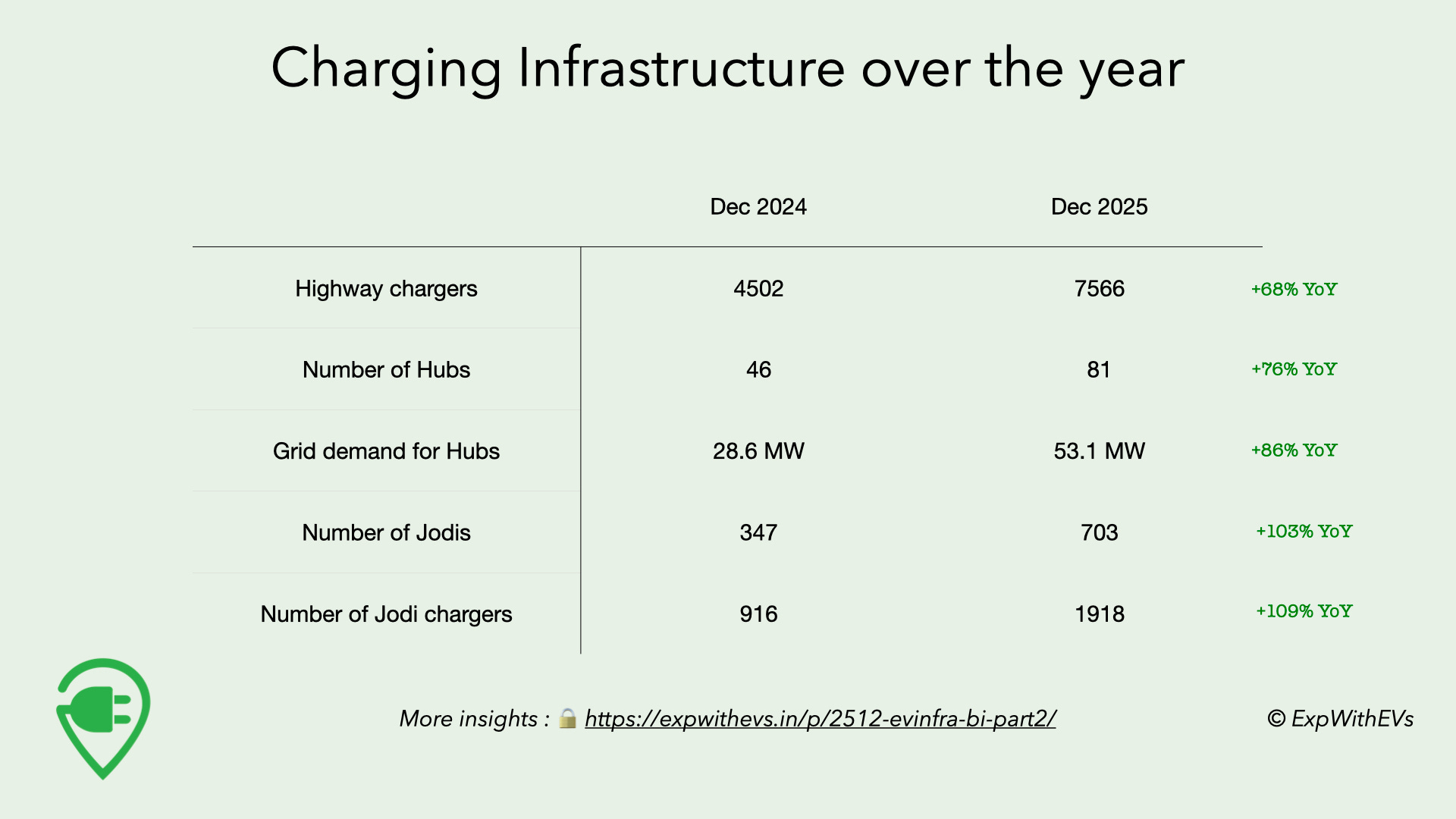
We continue to see growth in charging infrastructure over the year. Chargers on expressways and national highways now represent 47% of the total charging infrastructure. They grew to 7566 chargers by 68% this year.
A charging hub is defined as a space with ten or more connectors by a single operator. We are now at 81 such hubs in India, with a cumulative grid demand of 53.1 MW. Nine of those have a grid demand of over 1MW each. CPOs invest massive CapEx to build out a hub. We’ve wrote about how we see them as the future of EV charging, exactly a year ago.
The future of EV charging - hubs

An EV charging hub refers to a site with more than 10 charging points, which can include both CCS2 and Type2 connectors. These hubs are publicly accessible to all EV users, though some charging points may be reserved for captive users like fleet operators. We have excluded these reserved points from our numerical analysis.
Jodi is a pair of atleast two chargers by different CPOs within a one minute walk.
We saw over 100% growth Jodis and Jodi chargers in India. Over the year, CPOs in India have collectively put up 1918 chargers next to each other spread across 703 such locations. The Jodis are an interesting way to understand where CPOs believe there’s demand by electric vehicle owners. By studying the pricing, power rating, we can understand which CPO is targeting market share from which CPOs.
We analysed Glida’s in April last year.

Let’s now look at highways in detail.
Highways
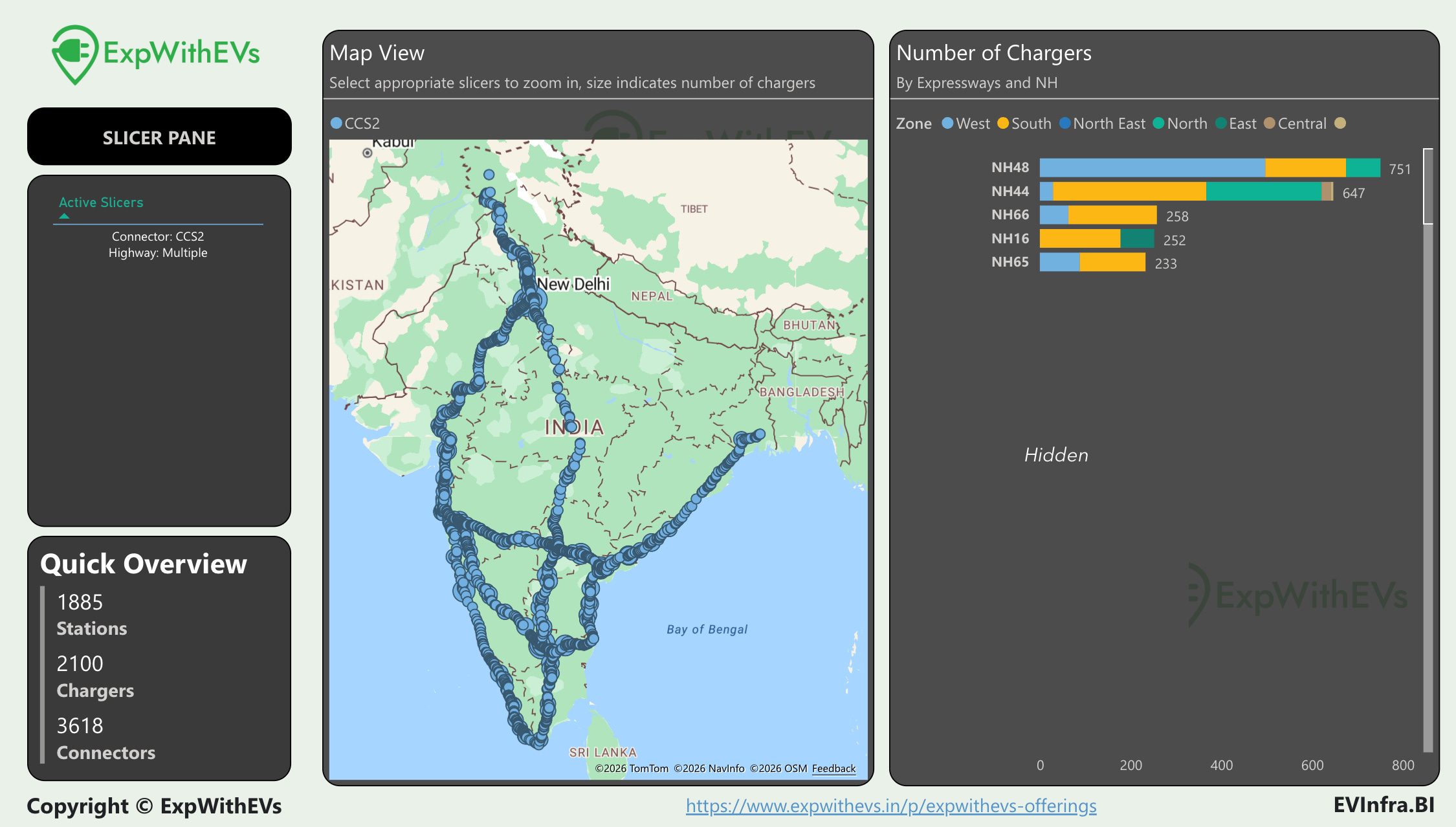
These are the top five highways for CCS2 public charging infrastructure in India. The most chargers are in South India, which has been consistent with rest of the country.
The charging infrastructure on NH48 and NH66 contributed to the high concentration of chargers along the Mumbai - Goa stretch (Bonus - Read about my 2023 road trip from Mumbai to Goa). While the other four highways have contiguous chargers, we do see some gaps on NH44. Rather, potential opportunities for CPOs to setup a charger or two in these gaps.
The picture drastically changes when we look at the same infrastructure from a 60kW and 120kW charger threshold. As the power rating goes up, the gaps increase. The high power charger count too, falls drastically. The highways (NH66 and NH65) no longer feature in the top five list either.


Imagine you are a CPO and would like to setup ten 120kW chargers on each of these highways? What all would you consider? Where would you like to host it? What do you think would be the utilization at the charger if you install it at a particular site?
Hosts
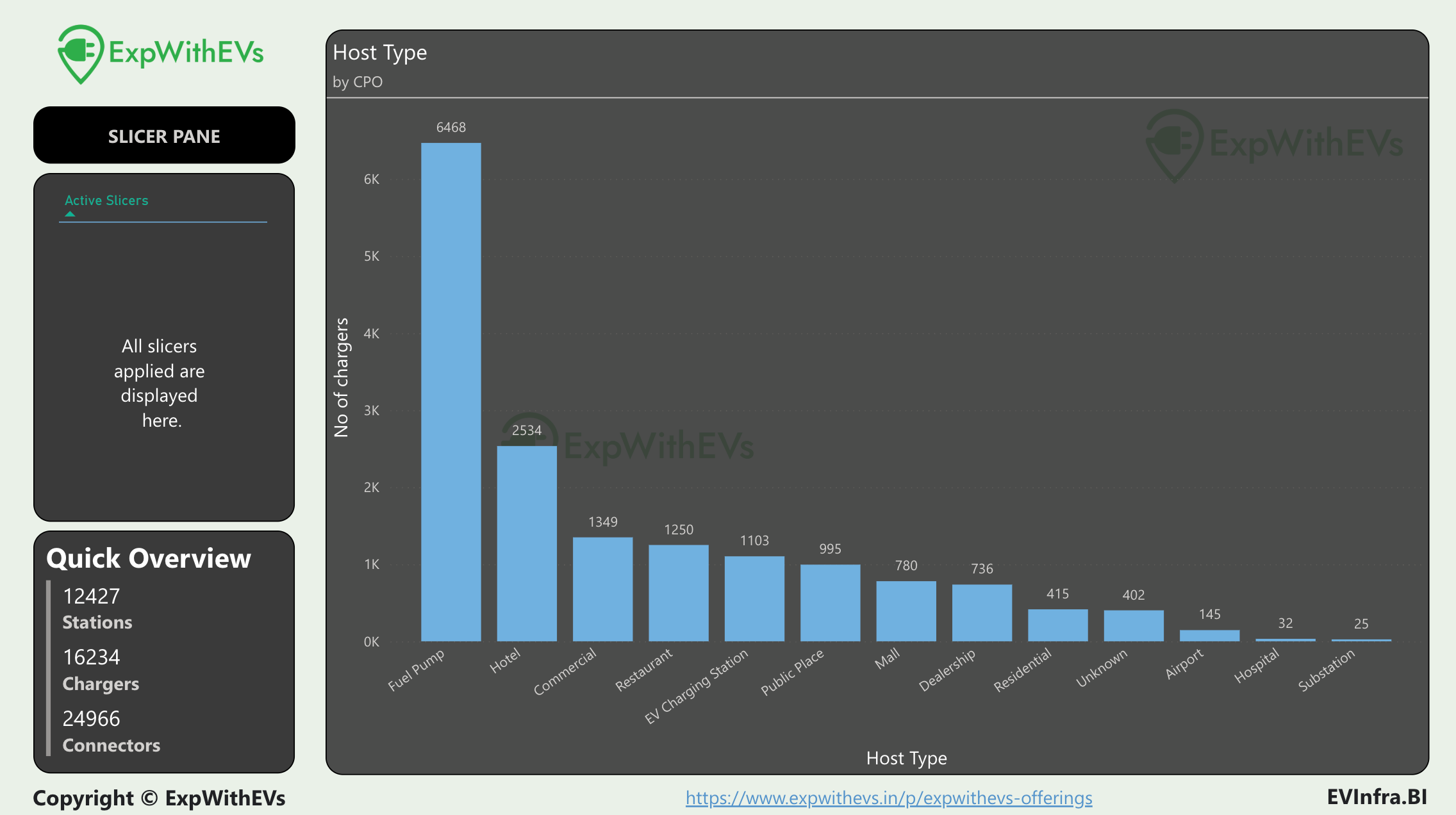
This chart includes both CCS2 and Type2 chargers. The dominant host type is fuel pumps, covering almost 40% of the entire network. The fuel pump host type has seen growth of 100% in 2025. We covered the high growth of Oil PSU CPOs two weeks ago.
The picture becomes a lot more interesting when we take out the Oil PSU CPOs. Other host types shine, with Hotels in the lead.
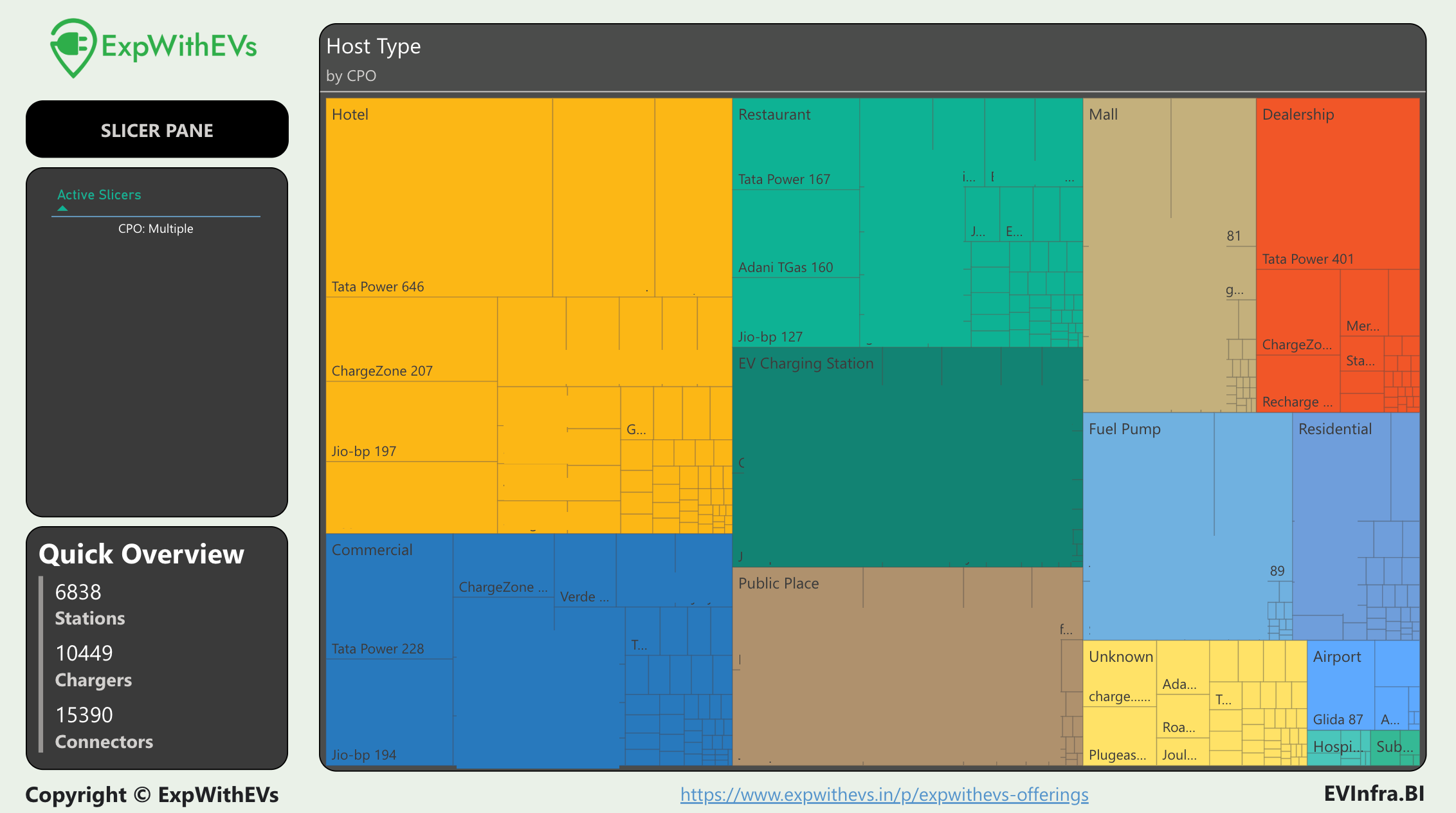
Tata Power leads in Hotels, Commercial Buildings and Restaurants. The top category, Hotels, saw 50% rise year on year. Restaurants and commercial buildings follow next in the ranking, grew by 100% year on year.
Adani TGas will overtake Tata Power as the most number of chargers at Restaurants in the next report. ChargeZone and Jio-bp are competing to take the second spot in the Hotel category. ChargeZone isn’t surprising because there’s a quick recall - “Oh Marriott brands have ChargeZone chargers” (Data check - almost 40% of ChargeZone’s Hotel host chargers are in Marriott). There’s value to have a strong brand associated with your CPO brand.
Another such branded category is Indian malls. They host less than 5% of India’s infrastructure. There was a muted 33% growth in this category.
The dealerships also saw only 16% growth year on year. The category will see a massive jump once, now restricted Maruti Suzuki charging network, becomes public. We put up the photo of their Exicom charger back in October 2024.
How Suzuki decisions will impact Indian EVs

The first memory of a car for most Indians aged 25 and above, is a Maruti car, mostly the 800 or the Omni. My family owned two models of the Maruti WagonR over two decades. The first car for most Indians was likely to be a Maruti product. Will the new generation Indians own their first electric car when Maruti launches the eVX?
You can subscribe to continue reading the analysis for hubs and Jodis, and more from our archive! It will help us continue publishing these reports and to do more.
